Detecting Seasonal Landslide Motion with InSAR at Huafan University (2021)
Long-term landslide monitoring often faces a practical problem: ground instruments require continuous maintenance, and gaps inevitably develop in otherwise valuable time series. Satellite radar offers an independent way to reconstruct surface deformation during such periods. Using Sentinel-1 radar imagery from 2014 to 2019, we applied multitemporal interferometry to the long-recognized slow-moving landslide at Huafan University in northern Taiwan. The satellite observations reproduced the main deforming areas identified by earlier field studies and revealed not only persistent gravity-driven movement but also a seasonal fluctuation associated with precipitation.
Abstract
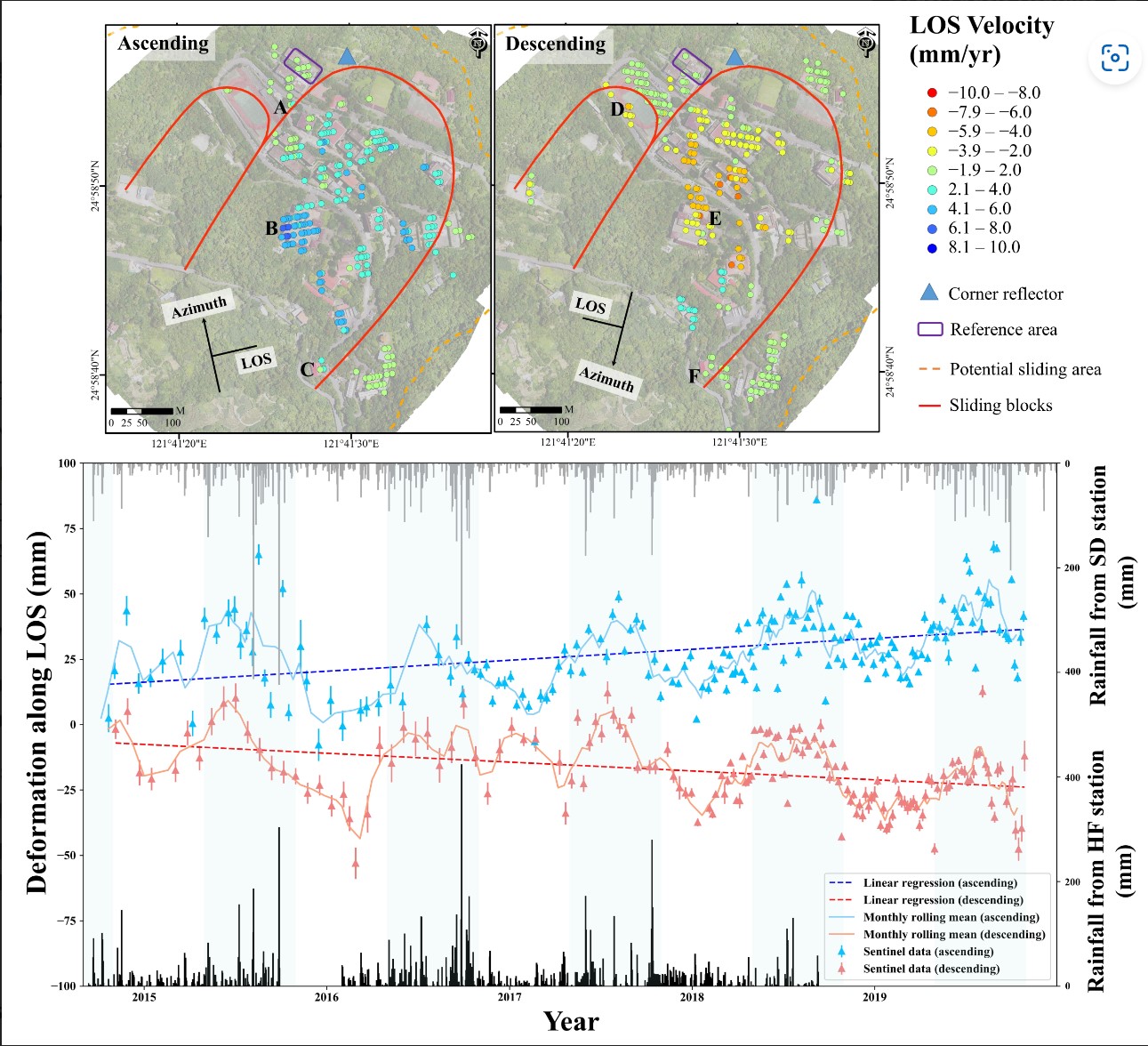
A slow-moving landslide on the Huafan University campus, which is located on a dip slope in northern Taiwan, has been observed since 1990. However, reliable monitoring data are difficult to acquire after 2018 due to the lack of continuous maintenance of the field measurement equipment. In this study, the multitemporal interferometry (MTI) technique is applied with Sentinel-1 SAR images to monitor the slow-moving landslide from 2014–2019. The slow-moving areas detected by persistent scatterer (PS) pixels are consistent with the range of previous studies, which are based on in situ monitoring data and field surveys. According to the time series of the PS pixels, a long period gravity-induced deformation of the slow-moving landslide can be clearly observed. Moreover, a short period seasonal surface fluctuation of the slow-moving landslide, which has seldom been discussed before, can also be detected in this study. The seasonal surface fluctuation is in-phase with precipitation, which is inferred to be related to the geological and hydrological conditions of the study area. The MTI technique can compensate for the lack of surface displacement data, in this case, the Huafan University campus, and provide information for evaluating and monitoring slow-moving landslides for possible landslide early warning in the future.
Citation
Lu, C.-Y., Chan*, Y.-C., Hu, J.-C., Tseng, C.-H., Liu, C.-H., & Chang, C.-H. (2021). Seasonal surface fluctuation of a slow-moving landslide detected by multitemporal interferometry (MTI) on the Huafan University campus, northern Taiwan. Remote Sensing, 13, 4006. https://doi.org/10.3390/rs13194006. (*corresponding author)