Satellite-Derived Seasonal Displacement and Soil Moisture Reveal Landslide Activity (2026)
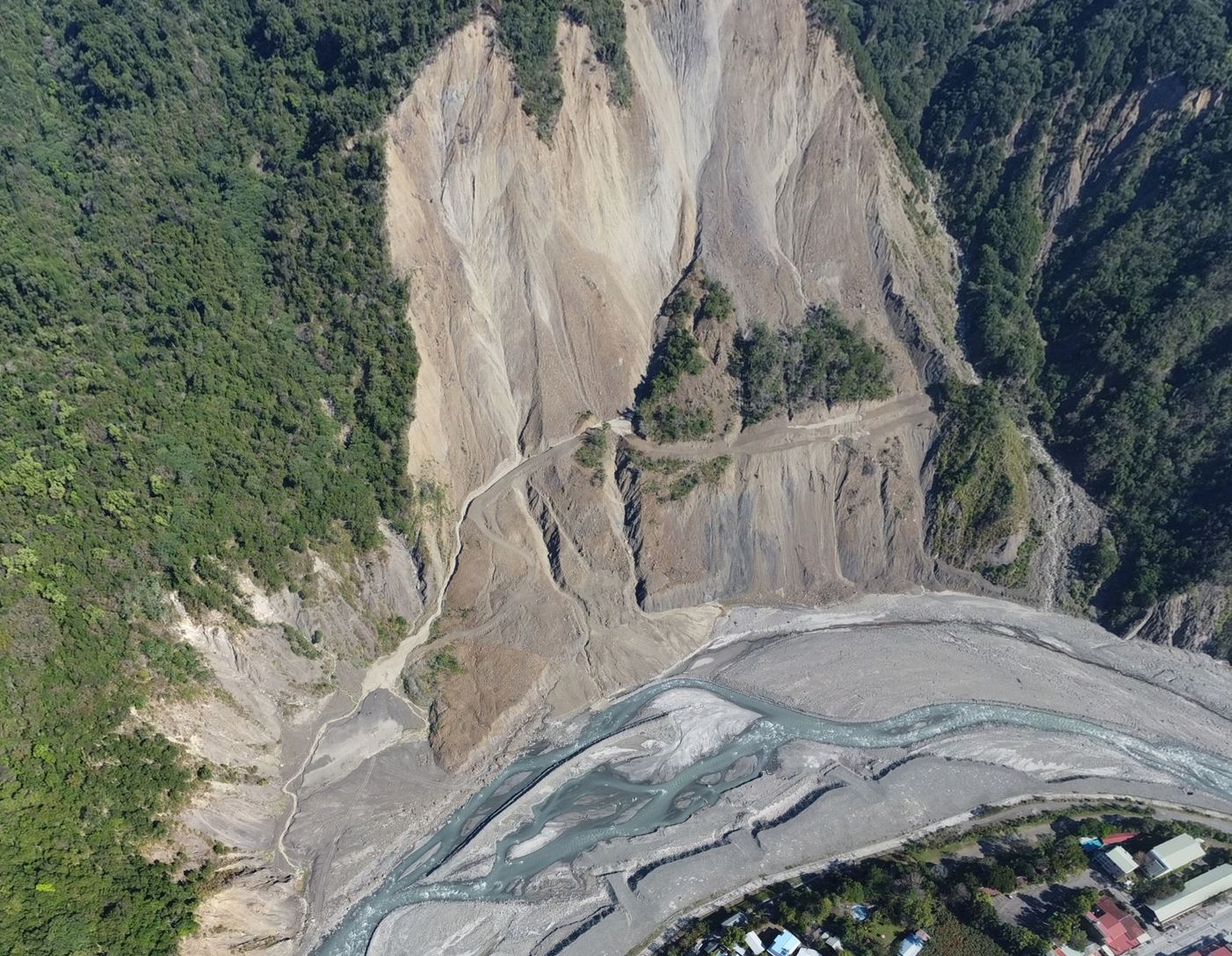
In this study, we combined satellite radar interferometry with satellite-derived soil moisture data to investigate two slow-moving landslides in different geological settings. The results show contrasting relationships between surface displacement and soil moisture. In sedimentary rocks, seasonal displacement is negatively correlated with soil moisture and is interpreted to be dominated by hydrological loading associated with water storage. In metamorphic rocks, the positive correlation suggests that increased pore-water pressure plays a more important role. The study demonstrates that integrating satellite displacement and soil moisture observations can help distinguish regular seasonal fluctuations from abnormal acceleration, improving the interpretation and early warning of slow-moving landslides.
本研究結合衛星雷達干涉技術與衛星土壤含水量資料,分析兩處位於不同地質環境中的緩慢移動型山崩。結果顯示,沉積岩區的地表位移與土壤含水量呈負相關,可能主要受到水分儲存所產生的水文負載影響;變質岩區則呈正相關,顯示孔隙水壓增加可能是控制位移的重要因素。研究說明,整合衛星地表位移與土壤含水量資料,可補充山區地面水文監測的不足,並協助區分正常的季節性波動與異常加速位移,提升緩慢移動型山崩監測與預警的判讀能力。
Abstract
Seasonal surface displacement is influenced by hydrological variations and geological conditions, complicating the interpretation of deformation time series for slow-moving landslides. This problem is particularly important in mountainous areas, where continuous measurements of groundwater level, pore-water pressure and soil moisture are often unavailable. We investigated two representative slow-moving landslides using the small baseline subset method within a multitemporal InSAR framework. The resulting displacement time series were compared with satellite-derived soil moisture, which was used as a proxy for average hydrological conditions across each landslide.
The two landslides showed contrasting relationships between soil moisture and seasonal surface displacement. In the sedimentary-rock setting, the negative correlation is interpreted to reflect the dominance of hydrological loading associated with relatively high water-storage capacity. In the metamorphic-rock setting, the positive correlation indicates that pore-water pressure likely exerts greater control on seasonal deformation. These results demonstrate that geological conditions can regulate how hydrological changes are expressed as surface displacement.
Combining satellite-derived soil moisture with InSAR observations provides a useful approach for investigating slow-moving landslides where field-based hydrological measurements are limited. Recognizing characteristic seasonal fluctuations may also help distinguish expected cyclic deformation from abnormal acceleration associated with increasing landslide activity, thereby contributing to improved monitoring and early-warning assessments.
Citation: Lu*, C.-Y., Chan*, Y.-C., Chu, C.-R., Liu, C.-H., Lee, S.-C., Hsieh, Y.-C., Hu, J.-C., & Chang, C.-H. (2026). Satellite-derived seasonal fluctuations in surface displacement and soil moisture: Implications for landslide activity. Science of Remote Sensing. https://doi.org/10.1029/2025JF008720. (*corresponding author)